Best Portable Water Filter Bottle for Travel & Microplastics
By Arjun Mehta • 14th Jun
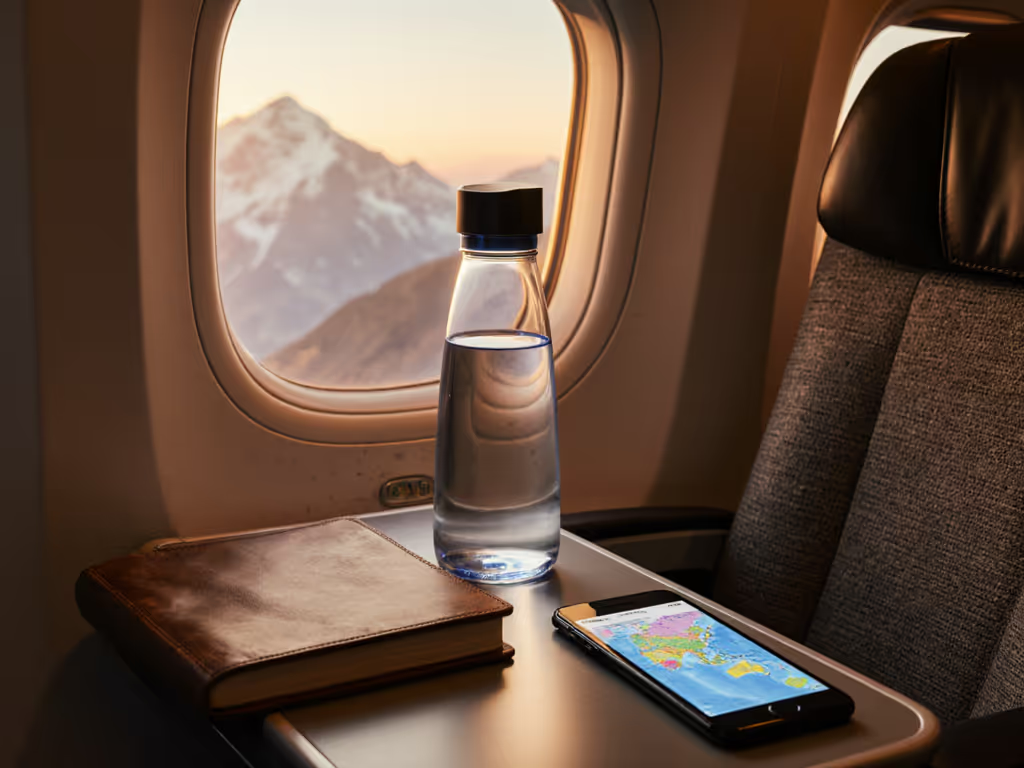
A portable water filter bottle is one of the few tools that can simultaneously cut plastic waste, tame sketchy tap water, and give you a realistic defense against microplastics - if you choose the right design and certifications. The wrong one is just an expensive sports bottle with a marketing story.
This FAQ-style deep dive breaks down how to choose the best water purifier bottle for travel, what actually counts as a microplastic water filter, and how to compare options on performance, cost per gallon, and waste footprint.
If you take nothing else from this article: map your water, then let certifications drive the filter choice.
FAQ 1 - Do I even need a portable water filter bottle, or is tap water "good enough" when I travel?
Short answer: If you only travel within North American and Western European cities with stable infrastructure, your tap is usually microbiologically safe, but may still contain chlorine byproducts, lead from plumbing, PFAS, and microplastics. For a deeper overview of common tap contaminants and health impacts, see our tap water safety checklist. For many other regions, or for camping, boil notices, and emergencies, a purifier-grade bottle is a much safer bet.
When a portable water filter bottle makes sense
Use a portable water filter bottle when:
- You want plastic-free travel filtration instead of buying single-use bottles.
- You move between cities with different water profiles and do not trust the hotel tap.
- You face boil-water advisories, wildfire-related taste/odor spikes, or aging building plumbing.
- You travel to countries where microbial risk (bacteria, protozoa, viruses) is higher in tap and surface water.
- You need backup water treatment for flights, road trips, and power outages.
When a full purifier bottle (not just a "filter") is warranted
According to outdoor and travel guides, filters are typically designed to remove protozoa and bacteria, while purifiers are rated (or at least tested) to remove viruses as well.
Look for a purifier bottle if:
- You’ll drink from lakes, rivers, or taps of uncertain safety in developing regions.
- You want protection against norovirus, rotavirus, and hepatitis A, which are too small for many standard backpacking filters.
- You want one bottle that covers trips from backcountry to big cities.
If you’re staying in U.S./Canadian cities and primarily worried about lead, PFAS, and microplastics in otherwise treated water, a tap-focused bottle filter (not necessarily a full virus purifier) can be a more efficient, higher-capacity choice.
FAQ 2 - What exactly are microplastics, and how do bottles remove them?
Microplastics are tiny plastic particles, often defined as <5 mm, with many tap-water particles in the 1-100 µm (micron) range according to global reviews (e.g., WHO 2019).
How microplastic removal works in bottles
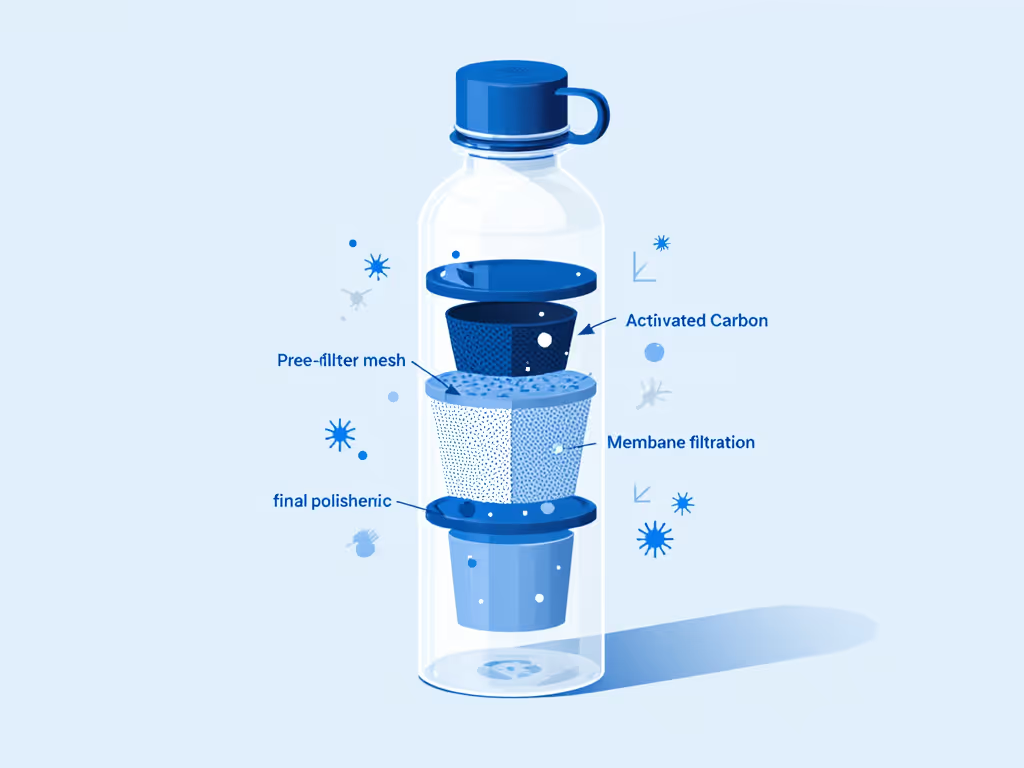
Portable bottles target microplastics mainly through:
- Physical size exclusion - membranes or hollow fibers with pore sizes in the 0.1-0.2 µm range can physically block most microplastic fragments, which are larger than the pores.
- Depth filtration - dense carbon blocks or composite media trap particles throughout their structure, not just on the surface.
- Electro-adsorptive media - some advanced purifiers use charged fibers or powders that attract and hold onto fine particles and colloids.
A YouTube lab-style test of popular portable water filters notes that some are rated to remove 99.99999% of bacteria and filter particles down to about 0.1 microns, including microplastics, while top-tier purifiers go further and remove viruses as well.
Key takeaway for microplastics
For microplastic water filter performance, focus on:
- Nominal pore size ≤0.2 µm for membrane/hollow-fiber elements.
- Solid carbon block or composite media rather than loose carbon "dust" alone.
- A manufacturer or lab report explicitly listing microplastic reduction (ideally with particle-size range) rather than vague "removes contaminants" copy.
If a bottle never mentions pore size, particle removal, or a test report, assume microplastic performance is unknown, not proven.
FAQ 3 - Which certifications matter for a portable water filter bottle?
This is where most people feel lost. Certifications are your shortcut through the marketing noise.
The big standards to know
Here’s a cheat sheet, using the most common NSF/ANSI and related standards referred to in credible water treatment discussions:
| Standard / Protocol | What it covers (in plain English) |
|---|---|
| NSF/ANSI 42 | Aesthetic: chlorine, taste, odor, some particulates |
| NSF/ANSI 53 | Health: heavy metals (lead, etc.), some VOCs |
| NSF/ANSI 58 | RO systems (less relevant for bottles) |
| NSF/ANSI 401 | "Emerging" contaminants: some pharma, pesticides, endocrine disruptors |
| NSF/ANSI 244 | Supplemental microbiological treatment on already-treated water |
| NSF/ANSI P231 | Microbiological purifier claims (bacteria, protozoa, viruses) |
| NSF/ANSI P473 | PFAS (PFOA/PFOS) reduction claims |
Some companies use WQA Gold Seal or IAPMO listings instead of NSF branding, but they generally reference the same standards. If you’re unsure about 42 vs 53 and which you actually need, read our NSF 42 vs 53 guide.
How this maps to portable bottles
Broadly:
- Backpacking/untreated-source purifier bottles often cite testing to NSF/ANSI P231 for virus removal (sometimes via independent labs rather than formal NSF listing).
- Urban/tap-focused bottles often emphasize NSF/ANSI 42 and 53, sometimes 401 and P473 for PFAS and emerging contaminants.
- Very few bottle systems are formally certified to the entire stack; more commonly, you see independent lab test reports quoting those protocols.
How to use this as a buyer
- Decide your use-case (tap only vs. tap + rivers).
- Demand at least:
- NSF/ANSI 42 or equivalent testing for taste/odor and chlorine.
- NSF/ANSI 53 for lead if you’re in an older building or city with lead concerns.
- NSF/ANSI P231 (or equivalent microbiological purifier test) if you’ll drink from untreated sources or risky taps.
- NSF/ANSI P473 or PFAS-specific testing if you’re in a PFAS headline region.
- Look for a model-specific listing or report, not a brand-level claim.
My bias is straightforward: I overweight NSF/ANSI certifications and detailed lab reports and heavily discount vague "independent lab tested" statements with no protocol named.
FAQ 4 - Filter vs purifier vs UV bottle: which is best for travel?
Portable water treatment comes in several flavors, many of which can be integrated into bottles:
- Filter bottles - usually hollow-fiber or carbon-based; remove protozoa/bacteria and particulates; may not remove viruses.
- Purifier bottles - combine mechanical + electro-adsorptive + carbon media to remove viruses, bacteria, protozoa, chemicals, and microplastics.
- UV purifier bottles - use ultraviolet light to inactivate microbes; they do not remove particles, metals, or chemicals, so microplastics and PFAS remain.
Which is "best" for your situation?
Use-case ranking:
-
International travel with iffy tap + occasional river water -> Prioritize a purifier bottle with microbiological (P231-type) testing.
-
North American/European city hop, worried about PFAS/lead/microplastics but not microbes -> A high-capacity urban filter bottle (42/53/401/473-type testing) often beats a backcountry-style purifier for cost per gallon.
-
Backpacking in North America, drinking from lakes/streams -> A backpacking filter + chemical backup (e.g., hollow-fiber squeeze with drops or tablets) is still the backpacking gold standard, with some bottle-integrated systems for convenience.
-
Ultralight carry-on-only traveler who usually trusts tap -> A compact, tap-focused filter bottle gives taste and basic contaminant reduction without the pump/press effort of a full purifier.
UV-only bottles can work for hotels where the primary concern is microbial (for example, older plumbing in otherwise treated systems), but they are not microplastic water filters and do nothing for PFAS, lead, or chlorine. For how UV works and its limits, see our UV water purifier science explainer.
FAQ 5 - How do I choose the best portable water purifier bottle for travel and microplastics?
Let’s treat this like a decision tree, not a popularity contest.
Step 1 - Map your water profile
Before you buy anything, do a quick triage:
- Home base municipal water: Pull your Consumer Confidence Report (CCR) from your utility’s site. Check for:
- Disinfectant (chlorine vs. chloramine)
- Lead, copper
- Nitrates, arsenic (if present)
- PFAS results (if any)
- Travel destinations: For major cities in developed countries, tap is usually microbiologically safe but may have taste, pipes, or PFAS issues. For many low- and middle-income countries, assume microbial risk even at taps.
- Emergency/backcountry: Factor in surface water (lakes, rivers) and the possibility of boil-water notices.
I learned the hard way when I moved into a high-rise where the utility’s "all good" story didn’t match the kettle scale and chlorine spike in my own kitchen. Pulling the CCR, cross-checking lab data, and running cost-per-gallon math on bottle cartridges made it obvious which models were actually doing work.
Step 2 - Decide your protection target
Rank your concerns:
- Microbes - bacteria, protozoa, viruses
- Metals - lead, copper, chromium, etc.
- Chemical & "emerging" contaminants - PFAS, pesticides, pharma, disinfection byproducts
- Microplastics & turbidity - visible particles, cloudiness
For microplastics + travel, I generally recommend:
-
Untreated or risky tap water: A purifier bottle with:
-
Sub-micron filtration (≤0.2 µm) for solids/microplastics.
-
Microbiological testing to a P231-type protocol.
-
Carbon or composite media for chemicals and taste.
-
Mostly treated city water, high on PFAS/lead/microplastics concerns: A tap-focused filter bottle with:
-
Certified or lab-tested reductions for lead (53), PFAS (P473), select pharmas/pesticides (401).
-
Small enough nominal pore size or solid-block design to meaningfully reduce microplastics.
Step 3 - Compare real performance, not just slogans
For each candidate bottle, check:
-
Pore size or microplastic reduction claim:
-
If the brand claims microplastic removal but lists no particle-size range or test protocol, treat that as marketing, not data.
-
Certified or independently tested reductions:
-
Ideally: a table of contaminants, initial concentration, final concentration, percentage reduction, and rated capacity.
-
Capacity at stated performance:
-
For example: "Up to 150 L at 95% lead reduction" is more meaningful than "filters up to 1,000 L" with no spec.
-
Flow and usability:
-
Press-style purifiers can take 10-20 seconds of push per fill but give strong protection.
-
Suck-through straws are lighter but often have higher resistance, especially as they clog.
At this point, you have enough to shortlist 2-3 models that genuinely tackle microplastics + your top contaminants.
FAQ 6 - How do I compare cost per gallon between portable bottles?
Here’s where we show your math instead of trusting "up to X gallons" blurbs.
Simple cost-per-gallon equation
Use:
Cost per gallon = (Bottle + initial filter + replacement filters over period) / Total gallons filtered over that period
Example (hypothetical numbers):
- Bottle + filter: $70
- Replacement filter: $30
- Each filter rated for 65 gallons at full performance (for example, for lead or PFAS).
- You expect to use 1 bottle fill (0.5 gallons) per day while traveling.
Over 1 year:
- Daily volume: 0.5 gallons x 365 ≈ 182.5 gallons
- Filters needed: 182.5 ÷ 65 ≈ 2.8 -> 3 filters total (1 included + 2 replacements)
- Total cost: $70 + 2 x $30 = $130
- Cost per gallon: $130 ÷ 182.5 ≈ $0.71/gal
Now compare that to buying bottled water:
- Suppose $1.50 for a 1-liter bottle (0.26 gal) in airports/hotels.
- Cost per gallon: $1.50 ÷ 0.26 ≈ $5.77/gal
Even a "pricey" purifier bottle can easily be 5-10x cheaper than bottled water, with far less plastic waste, once you do the math. For a full environmental and cost comparison of bottled vs filtered water, see our bottled water vs filtered analysis.
Watch out for two common traps
- Overstated capacity - some brands advertise huge gallon numbers but do not guarantee full contaminant reduction for that entire volume. Always read the small print.
- Proprietary, short-lived cartridges - a cheap bottle with 25-30 gallon filters can end up more expensive than a premium purifier with 65-100 gallon cartridges.
FAQ 7 - Are portable water filter bottles eco-friendly, or just greenwashing?
From an environmental standpoint, what matters is plastic and water avoided per gallon.
Plastic footprint
Each single-use 1 L bottle:
- Weighs roughly 20-30 grams of PET plastic.
- Using our earlier example of 182.5 gallons/year (≈690 liters), that’s ≈690 plastic bottles avoided.
Even if your purifier cartridge weighs 100-150 g of plastic and media, you’re still avoiding dozens of kilograms of disposable plastic per year of heavy use.
Waste and lifespan questions to ask brands
-
Is the bottle itself durable? Stainless or high-grade BPA/BPS-free plastics that last years beat flimsy shells.
-
Can filters be recycled or returned? Some companies offer mail-back or component recycling; others don’t.
-
What’s the real capacity per cartridge? Higher capacity = fewer cartridges shipped and trashed over time.
-
Does the bottle rely on batteries (UV models)? Consider battery replacement and end-of-life.
For most travelers, a well-chosen portable water filter bottle dramatically cuts plastic waste, but only if you actually use it instead of buying bottled water.
FAQ 8 - Is a portable bottle enough for emergencies and boil-water notices?
It depends on the bottle’s microbiological performance and the type of contamination.
Authoritative outdoor and emergency guidance still treat boiling as the gold standard for killing pathogens in water, recommending bringing water to a rolling boil for at least 1-3 minutes depending on altitude.
For typical boil-water notices
- If the notice is due to microbial contamination and you own a bottle tested to a P231-type microbiological purifier standard, that bottle is a reasonable emergency tool.
- If your bottle is only certified to 42/53 (chemicals, metals) but not microbes, you should:
- Boil first, then run through the bottle for taste and chemical polishing.
For chemical spills
No portable bottle can handle every chemical.
- A good purifier/filter bottle may significantly reduce many organics, some solvents, and some PFAS, but will not reliably remove all industrial contaminants.
- In event-specific emergencies (train derailment, chemical spill), follow public health guidance and rely on bottled or trucked-in water until the situation is clear.
A high-quality bottle is an excellent first-line and backup tool, but it is not a universal disaster solution.
FAQ 9 - Maintenance: how do I know my portable water filter bottle is still working?
Maintenance is where performance quietly dies in real life.
Practical maintenance rules
- Track gallons or days, not vibes.
- Use the manufacturer’s rated capacity and your typical daily volume.
- Example: 65 gallons capacity / 0.5 gallons per day ≈ 130 days of use.
- End-of-life indicators:
- Some bottles have flow slowdown as the primary indicator (clogging).
- Others use time-based reminders via apps or simple date wheels.
- Microbial filters after dirty water use:
- Follow manufacturer instructions for backflushing or drying (if applicable) to reduce biofilm and extend life.
- Storage between trips:
- Do not leave a wet filter sealed for months; that can encourage microbial growth.
- Many brands recommend drying the element or storing it in the fridge if it must remain moist (check their instructions).
Why TDS meters are not helpful here
Total Dissolved Solids (TDS) meters measure conductivity, which mainly reflects dissolved salts. A bottle that targets lead, PFAS, microplastics, or pathogens may not dramatically change TDS, and that’s fine.
A TDS reading going down (or not) tells you almost nothing about whether your bottle is still removing lead, PFAS, or microplastics. Look to:
- Certification capacity limits
- Time/gallon tracking
- Flow behavior
not cheap pens.
FAQ 10 - Putting it all together: what’s the "best" portable water filter bottle for travel and microplastics for you?
Rather than naming a single winner, I’ll frame three archetypes and which one to prioritize.
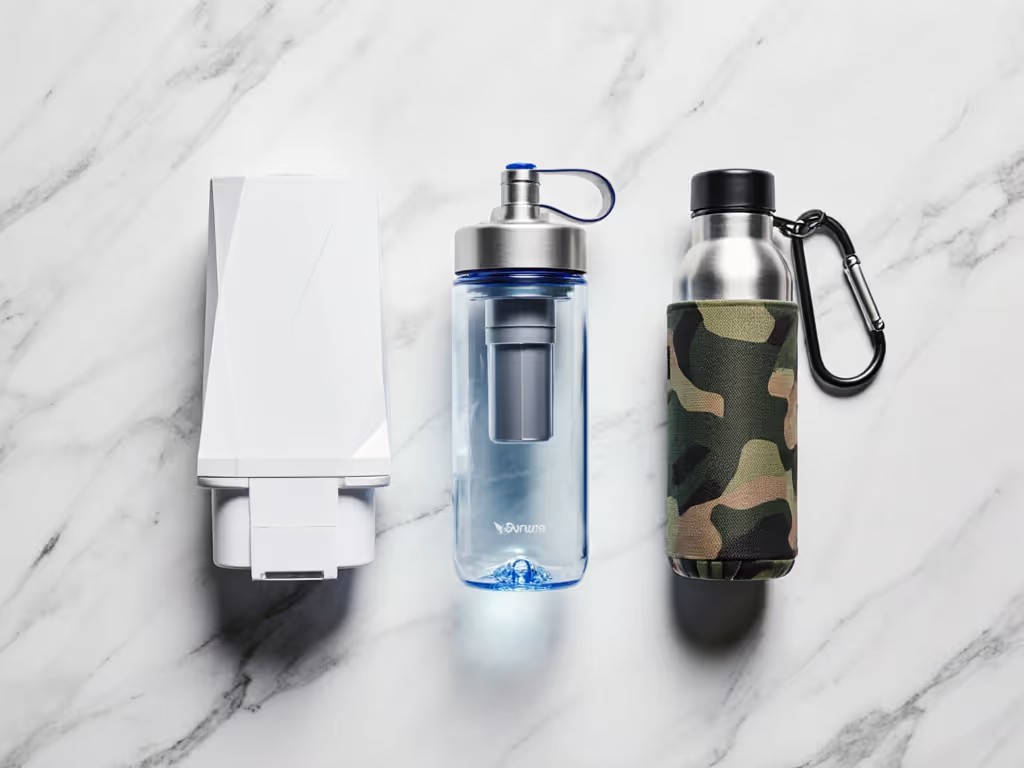
Archetype A - The Global Purifier Traveler
Profile:
- Regularly visits countries with uncertain tap safety.
- Drinks from taps, hotel sinks, and occasional rivers/lakes.
- Wants one bottle to cover both city trips and backcountry.
What to prioritize:
- Microbiological purifier performance (bacteria, protozoa, viruses) with P231-type testing.
- Sub-micron filtration for microplastics.
- Strong chemical and heavy metal reduction (at least 42; ideally 53/401-type testing where available).
- Press or pump-style design to avoid exhausting suction effort.
Tradeoffs:
- Higher upfront cost.
- Slightly slower to operate (press/pump per fill).
- Cartridges often have lower gallon capacity than tap-only filters.
Archetype B - The Urban & Suburban Tap Optimizer
Profile:
- Lives in North America or Europe; tap is treated but imperfect.
- Concerned about PFAS, lead, chlorine byproducts, and microplastics.
- Travels mostly to other cities and wants plastic-free travel filtration.
What to prioritize:
- NSF/ANSI 42 & 53 certifications or equivalent testing for chlorine and lead.
- NSF/ANSI 401 & P473-type testing or explicit PFAS/emerging contaminant data.
- A design that physically removes microplastics (solid block or ≤0.2 µm media).
- Higher capacity cartridges (e.g., 65-100 gallons) for better cost per gallon.
Tradeoffs:
- May not be suitable for untreated backcountry water or risky international taps (no virus rating).
- You might still need a backup (boiling, tablets) for true emergencies.
Archetype C - The Lightweight Backpacker/One-Bagger
Profile:
- Prioritizes weight and packability.
- Drinks mostly from surface water in developed regions or from taps that are microbiologically safe.
What to prioritize:
- Hollow-fiber filter bottles or squeeze systems that integrate with bottles, rated for bacteria/protozoa.
- Compatibility with bladders or soft bottles for longer hikes.
- Clear maintenance instructions (backflushing, field cleaning).
Tradeoffs:
- Limited chemical, metal, PFAS, and microplastic data vs. urban-focused filters.
- Most backpacking filters are not virus purifiers unless explicitly tested as such.
Summary & Final Verdict
If your goal is the best portable water purification for travel and meaningful microplastic reduction, the "best" bottle is the one whose tested performance matches your specific use-case:
- For global, unsafe taps + rivers -> choose a purifier-grade bottle with P231-type microbiological testing, sub-micron filtration, and multi-stage media for chemicals and metals.
- For North American/European taps with PFAS/lead/microplastics worries -> prioritize a tap-focused bottle with NSF/ANSI 42/53/401/P473-style testing and solid microplastic removal claims, plus long-life cartridges for strong cost per gallon.
- For backpacking-first travelers -> a lightweight hollow-fiber filter system paired with chemical backup remains the most field-proven stack, with bottle integration for convenience.
Whichever direction you go, demand three things:
- Clear standards and test reports (42, 53, 401, P231, P473, or equivalent), tied to the exact model, not just the brand name.
- Transparent math on capacity and cartridge costs so you know your true cost per gallon.
- A realistic plan for maintenance and cartridge replacement so performance doesn’t quietly decay.
If your bottle can prove its claims on paper and in your spreadsheet, it will pay for itself quickly - on your wallet, your plastic footprint, and your peace of mind when you fill it from a sketchy-looking tap.
Related Articles