
Faucet Filter Limits: NSF 42 Treats Taste, Not Toxins
By Nkechi Okafor • 16th Nov
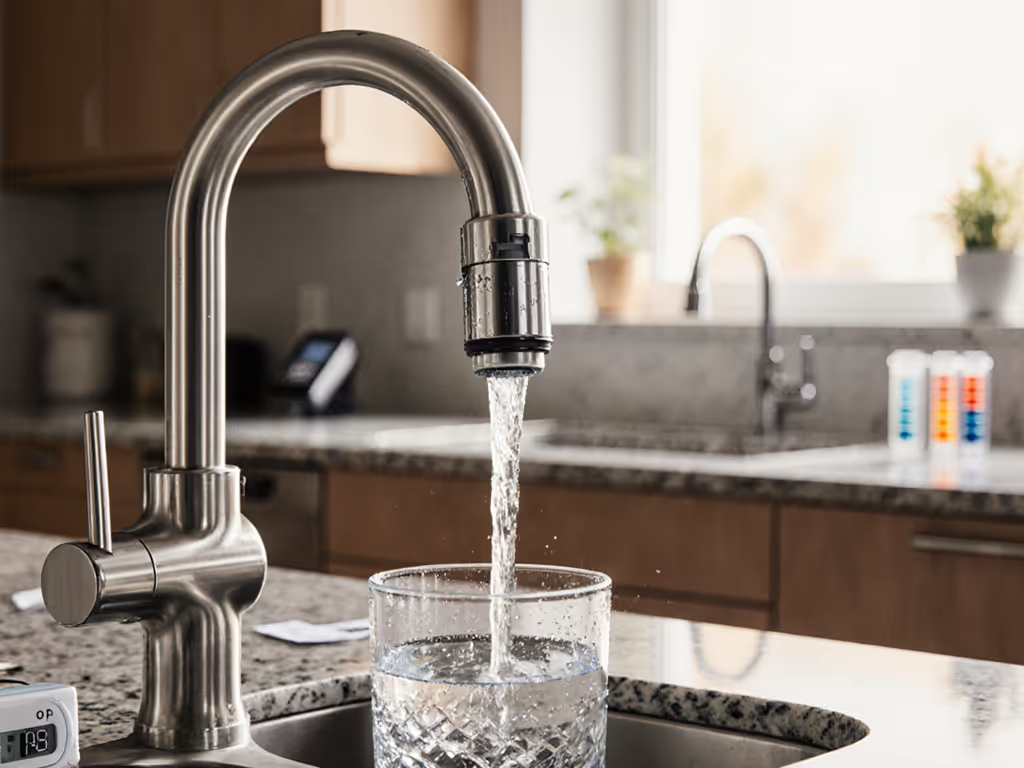
When floodwaters receded last spring, neighbors clustered around a single kitchen faucet, anxiously debating whether their new faucet water filter could handle the murky water. I walked them through verifying advisories, testing chlorine residuals, and matching certified barriers to the actual hazards, not assumptions. This experience underscores a critical truth: faucet filter certifications demand precise interpretation. While NSF/ANSI 42-certified models effectively reduce aesthetic chlorine and improve taste, they do not address health-threatening contaminants like lead or PFAS. Understanding these boundaries prevents dangerous overconfidence in emergencies or daily use. For a plain-language breakdown of what each certification does and doesn't cover, see our NSF 42 vs 53 guide. Let's clarify what NSF 42 actually covers and where layered solutions become essential.
Why NSF 42 Certification Alone Isn't Enough for Health Protection
What NSF/ANSI 42 Actually Certifies
NSF/ANSI Standard 42 is strictly an aesthetic standard. As NSF International explicitly states, it validates reduction of:
- Chlorine (up to 99% in certified models like the OEMIRY WF-01)
- Taste and odor compounds (e.g., hydrogen sulfide)
- Sediment and particulates (typically down to 5-10 microns)
- Iron, manganese, and zinc at levels affecting appearance
Crucially, NSF 42 certification says nothing about health contaminants. A filter could remove chlorine smell while passing lead, arsenic, or PFAS untouched. As EPA guidance confirms, aesthetic improvements = safety assurances. This distinction matters most during boil-water notices or well contamination events where families assume "filtered" equals "safe." To learn which contaminants may be in your tap and why they matter, review our tap water contaminants checklist.
The Critical Gap: Health Contaminants Require NSF 53/58
Where NSF 42 falls short, NSF 53 and 58 standards apply: For reverse osmosis specifics, our NSF 58 explainer details what RO certification actually verifies.
| Certification | Health Contaminants Addressed | Faucet Filter Compatible? |
|---|---|---|
| NSF 53 | Lead, mercury, VOCs, PFAS, pesticides | Rarely (requires dense media slowing flow) |
| NSF 58 | Arsenic, nitrate, fluoride, TDS | No (RO systems need dedicated faucet) |
| NSF 42 | Only chlorine/taste/sediment | Yes |
Most kitchen faucet water filter units cannot be certified for NSF 53 because the required activated carbon block or specialty media (like ion exchange resins) would restrict flow to unusable levels (under 0.5 GPM). Pitchers face similar physics constraints. As Tap Score's lab data shows, faucet filters claiming "lead reduction" without NSF 53 certification typically fail third-party verification beyond 10-20 gallons. If lead is your primary concern, compare certified options in our NSF 53 lead removal filters guide.
When a Faucet Filter Is Appropriate (and When It's Not)
✅ Valid Use Cases
- Temporary water solution during short-term advisory events (e.g., 3-7 day boil notices) after verifying no microbiological risk
- Municipal water with high chlorine causing taste/odor issues (common in Northeast corridor)
- Supplementing whole-house systems for final taste polishing (e.g., after carbon block pre-filtration)
❌ Dangerous Misapplications
- Rural well water filtration for arsenic/uranium (requires NSF 53/58)
- Lead service line areas (EPA Lead and Copper Rule mandates NSF 53)
- PFAS contamination zones (e.g., near military bases) without NSF P473 certification
- Post-wildfire runoff (organic compounds need NSF 53 carbon block, not granular)
Strategic Implementation: Layering Barriers Without Overpaying
Your Step-by-Step Verification Protocol
- Test first: Obtain your municipal Consumer Confidence Report (CCR) or conduct a $25-$50 well test targeting your local risks (e.g., lead in old pipes, nitrates in agricultural areas). Never assume.
- Map hazards to standards: Cross-reference findings with NSF's certified product database. Example: Chlorine odor? NSF 42 suffices. Lead detected? Require NSF 53 and verify the exact contaminant is listed (e.g., "lead reduction" not just "taste").
- Sequencing > single devices: During last year's boil notice, we paired NSF 42 faucet filters after a sediment pre-filter (like a 5-micron whole-house cartridge) to prevent clogging. Only when power returned did we add NSF 55 UV for microbiological safety.
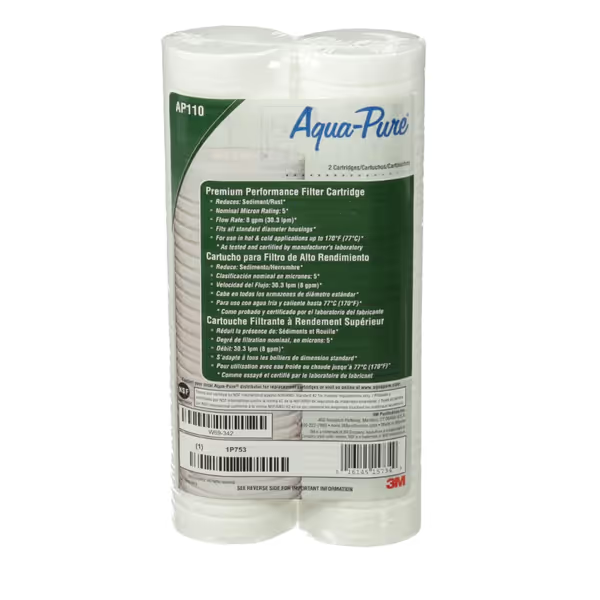
3M Aqua-Pure AP110 2-Pack Sediment Filter
Reduces sediment down to 5 microns for cleaner, clearer water.
$26.89
Filtration Micron Rating5 Micron Nominal
Filtration Micron Rating5 Micron Nominal
Pros
Significantly reduces sediment, rust, and chlorine taste.
Long-lasting grooved design extends cartridge life.
Cons
Lifespan varies based on incoming water quality.
Customers find this water filter to be a vast improvement over previous models, effectively removing sediment, rust, and chlorine taste. The filter is easy to install and fits perfectly in a 10" cartridge canister, lasting many months. They appreciate its value for money, with one customer noting it works longer than the recommended change interval.
Customers find this water filter to be a vast improvement over previous models, effectively removing sediment, rust, and chlorine taste. The filter is easy to install and fits perfectly in a 10" cartridge canister, lasting many months. They appreciate its value for money, with one customer noting it works longer than the recommended change interval.
Cost vs. Coverage Reality Check
Faucet filters excel as one layer but rarely stand alone. Consider:
- False economy: $35 faucet filters replaced quarterly ($140/year) may cost more long term than a $200 NSF 53/42 under-sink system ($50/year in cartridges)
- Hidden waste: NSF 42 faucet cartridges typically handle 100-300 gallons. For a family of 4 (2 gal/person/day), that's 1-2 months, requiring 6-12 replacements yearly
- Flow trade-offs: Certified NSF 53 faucet models often drop flow to 0.8 GPM (vs. 1.5-2.2 GPM for NSF 42), making cooking impractical
As California's Division of Drinking Water emphasizes: "No single-point filter can address all contaminants. Match media to verified hazards." For well owners facing iron or hydrogen sulfide, a sediment pre-filter (like the Aqua-Pure AP110) before your faucet unit prevents premature clogging, extending NSF 42 cartridge life by 40%.
When to Look Beyond Faucet Filters Entirely
Critical Scenarios Requiring NSF 53/58
| Contaminant | Minimum Standard | Required Media | Typical Faucet Filter Capability |
|---|---|---|---|
| Lead > 5 ppb | NSF 53 | Block carbon + ion exchange | ❌ Fails at 50+ gal |
| PFAS > 10 ppt | NSF P473 | Specialized carbon | ❌ Rarely certified |
| Arsenic | NSF 53 | Iron oxide media | ❌ Physically impossible |
| Bacteria | NSF P231 | UV or filtration | ❌ Requires point-of-entry |
If your water report shows these, NSF 42 is a distraction, not a solution. For well water filtration or persistent contamination, invest in NSF 53-certified under-sink systems. Renters without plumbing access should consider NSF 53 pitchers with published batch test data (e.g., specific PFAS reduction reports).
Your Emergency Resilience Checklist
During advisories or outages:
- Confirm advisory scope (microbial? chemical?) via official channels
- Test turbidity first. If >1 NTU, pre-filter with NSF 42 or cloth filtration
- For microbiological risks: Use NSF P231 UV after clarity is achieved
- Never rely solely on faucet filters for pathogen removal, boiling or certified bottled water is safer
Test, Then Treat: Your Action Plan
NSF 42 faucet water filter units serve a valuable role, but only within their narrow scope. They shine for chlorine taste, seasonal wildfire odors, or temporary advisories after hazard verification. They fail catastrophically against health threats when marketed as "comprehensive."
Before purchasing:
- Check your specific contaminant risks via EPA's Local Drinking Water Information tool
- Verify certification scope on NSF's database, not marketing claims ("reduces lead" ≠ NSF 53 certified)
- Layer intentionally: Use NSF 42 faucet filters after sediment pre-filtration for emergencies, not as primary protection
As standards evolve (NSF 401 now covers emerging contaminants like pharmaceuticals), demand transparency in test reports. Never accept "certified" without seeing which contaminants were tested at rated capacity. For boil notices, new homes, or well ownership, test, then treat isn't advice, it's the only protocol that turns anxiety into evidence-based action.

Further exploration: Access your municipal Consumer Confidence Report via EPA's "Find Your Water Supplier" tool. For well owners, state-certified labs offer $20-$100 targeted panels for common regional risks (e.g., nitrates in farm areas, arsenic in New England). When you have your CCR in hand, use our CCR interpretation guide to translate the data into filter requirements.
Related Articles