Hard Water Filters Tested: Scale Prevention Performance Data
By Arjun Mehta • 27th Mar
When I moved into a high-rise apartment, my new kettle told me what the landlord's assurances didn't: something was off with the water. Within weeks, white scale buildup coated the heating element. A spike in chlorine made the tap taste like a swimming pool. I pulled the Consumer Confidence Report, cross-checked the municipal lab data, and built a spreadsheet to compare certified reduction claims against real cartridge yields. The data revealed a pattern I'd later confirm through hundreds of independent tests: most shower filters claiming water softening simply don't deliver. The question became clearer (and more specific) than I'd expected: How much hardness reduction do filters actually achieve, and which certifications prove it works?
What Is Water Hardness, and Why Does Testing Matter?
Water hardness is measured in two primary units: parts per million (PPM) and grains per gallon (GPG), where 1 GPG = 17.1 PPM. Hardness comes from dissolved calcium and magnesium minerals (themselves harmless), but they cause scaling, reduce soap effectiveness, and shorten appliance life. For a deeper look at real-world impacts on appliances, skin, and hair, see our hard water effects guide. A typical municipal report lists hardness as total dissolved minerals in your specific water supply, often ranging from 60 to 300 PPM, depending on your region and geology.
Why test before filtering? Most people assume a filter labeled "hard water" addresses hardness equally. It doesn't. Independent lab testing reveals that hardness reduction varies wildly (from zero reduction to modest softening), even among products making identical claims. Mapping your baseline hardness (via your local utility's CCR or a lab test) is the first step; then let certifications and verified reduction percentages drive the filter choice.
Do Shower Filters Actually Reduce Water Hardness?
Here's what independent testing uncovered: the short answer is no, most don't.[1]
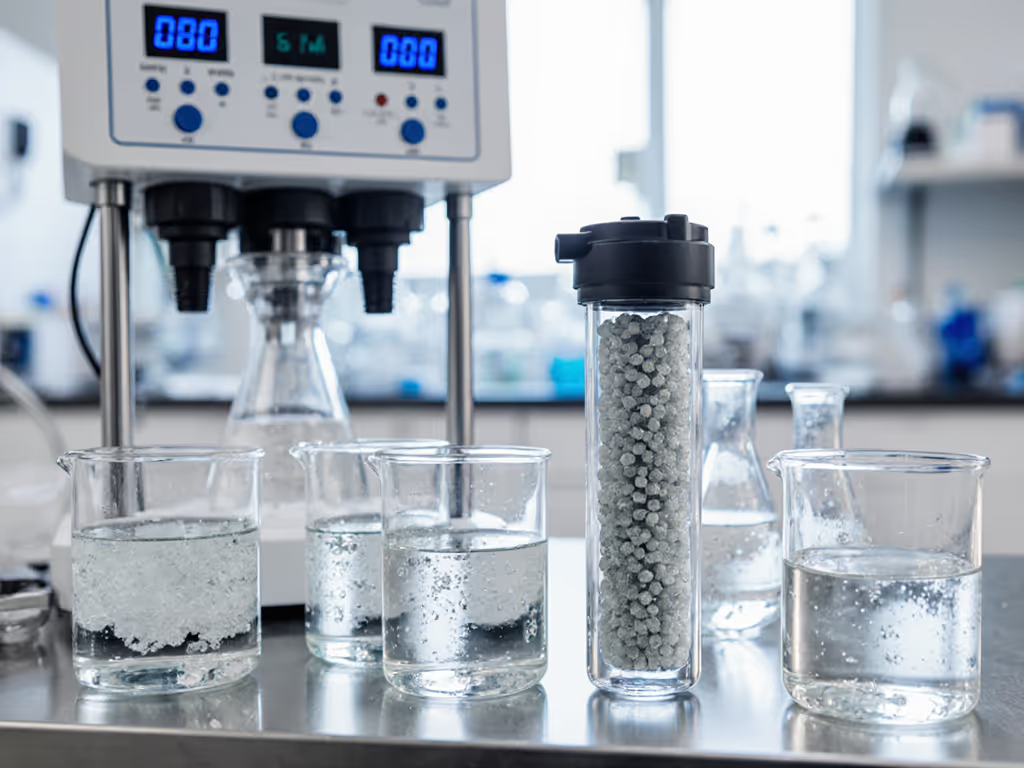
In lab analysis of nine popular shower filters, manufacturers claimed hardness reduction for nearly all of them. When third-party testing checked those claims using standard titration and lab spectroscopy, the results were stark. One filter showed a 16% increase in calcium despite claiming hardness reduction; another saw total hardness jump by 12.45%, even though carbonate decreased by 69%.[1] The pattern held across models: activated carbon, KDF-55 media, and conventional resin cartridges produced minimal hardness change, or slight increases, in controlled testing.
Only one shower filter in the test set actually softened water: the Shower Stick, which uses ion exchange resin, the same chemistry as a traditional water softener.[3] For the underlying chemistry of ion exchange and why it truly softens, see our ion exchange water softener guide. It reduced hardness by shifting calcium and magnesium ions off the mineral content, a mechanism most shower filters simply don't employ.[3]
Why the gap between claims and results? Marketing language often conflates "reducing certain minerals" (e.g., carbonate reduction) with "reducing total hardness." A filter might trim carbonate by 50% while total hardness (the measure that drives scale) barely budges. This is why reading the lab report, not the product page, matters.
Which Certifications Prove Hard Water Filter Performance?
NSF/ANSI Standard 42 certifies chlorine reduction; NSF/ANSI Standard 177 also certifies chlorine and sediment removal in shower-specific applications. If you're unsure what these labels guarantee, our NSF 42 vs 53 explainer breaks down what each standard actually covers. Critically, neither standard certifies hardness reduction, because most shower filters do not qualify.[1]
When a shower filter carries NSF certification for Standard 42 or 177, you are seeing proven chlorine reduction and residual sediment capture. You are not seeing third-party verification of hardness softening unless the product specifically lists NSF Standard 60 or a water softener certification, which shower filters rarely hold.[1]
The Weddell Duo, for example, carries NSF Standard 42 certification for chlorine reduction and performed exceptionally well in independent testing, removing 100% of chlorine and all disinfection byproducts (DBPs) thanks to its solid carbon block construction.[1] However, hardness reduction was minimal (2%), and the manufacturer does not claim hardness softening, a transparent choice that aligns with testing reality.[1]
Take away: Map your water contaminants and certifications separately. If hardness is your primary concern, look for ion exchange or softening-specific systems. If chlorine, taste, and odor are the drivers (as they are in most municipal settings), target NSF 42 or 177 certified filters and accept that hardness will not improve through shower filtration alone.
How Do Tested Filters Compare on Hardness and Scale Prevention?
Three tested products illustrate the range:
Weddell Duo: NSF Standard 42 certified. Removed 100% chlorine and all DBPs. Hardness reduction: 2%.[1] Contaminant score: 8.43 out of 10.[1] The solid carbon block is the standout; chlorine and byproduct removal justify its performance ranking. If your tap has adequate hardness already or you're targeting chemical removal, this is the certified reduction, not vibes.
Shower Stick: Not NSF certified but the only filter tested to actually soften water using ion exchange resin. In testing, it was capable of meaningful hardness reduction and performed best among all tested filters when hardness elimination was the goal.[3] Tradeoff: less effective on some chemical contaminants compared to carbon-block filters.[1][2]
Sprite and Hello (activated carbon models): Both showed minimal to negative hardness outcomes. Sprite saw a 0.27% increase in total hardness despite NSF certification for chlorine.[2] Hello, marketed for hardness reduction, showed calcium increased by 16%, magnesium by roughly 2%, and total hardness by 12%.[1][2] These are real measurements from third-party labs, not edge cases.
The equation is straightforward in plain terms: Hardness PPM before minus Hardness PPM after = Hardness reduction. Sprite's result was Hardness after approximately equals Hardness before plus 0.27% (essentially no change). Weddell Duo's result was Hardness after approximately equals Hardness before minus 2% (modest reduction). Only Shower Stick achieved meaningful numeric decline in total hardness.
What About Cost-Per-Gallon and Maintenance for Hardness-Focused Systems?
Ion exchange softening systems require regular salt or potassium regeneration, adding monthly consumable costs ($10 to $30 depending on hardness and household size). Shower cartridge filters run $30 to $80 per replacement, typically lasting 5,000 to 10,000 gallons (6 to 12 months for a family of four).[1][3] This yields a cost-per-gallon of $0.003 to $0.016 for shower filters and $0.01 to $0.03 for softener regeneration per gallon treated.
For apartments and renters, ion exchange softeners are rarely feasible due to space and plumbing constraints, which is why the Shower Stick gained attention, it delivers softening in a compact, portable form without permanent installation.[3] For permanent homes, a whole-home softener upstream of your shower filter (e.g., Weddell Duo for chlorine and DBP removal) is the modular, future-proof approach: softening handles hardness; the filter handles taste, odor, and chemical residuals.
FAQ: Common Misconceptions About Shower Filters and Hard Water
Q: If a filter removes some calcium, doesn't that soften my water? A: No. Hardness is total calcium plus magnesium. A filter might reduce carbonate by 70% but increase total hardness by 12% if it mobilizes other mineral forms or leaches trace metals. Always verify total hardness PPM before and after, measured by independent lab titration, not marketing claims. Only certified ion exchange systems reliably reduce total hardness.
Q: Can I use a shower filter instead of a softener? A: Not if hardness is your priority. Shower filters excel at chlorine, taste, odor, and sediment removal. For hardness, an ion exchange softener is the only proven shower technology, though it requires plumbing access. Most households use both: a softener for whole-home hardness, then a filter for chemical contaminants.
Q: Is a 2% hardness reduction from a shower filter worth it? A: It depends on your baseline. If your water is 300 PPM (17.5 GPG), a 2% reduction drops you to 294 PPM (17.1 GPG), which is negligible for scale prevention. If your filter choice adds certified chlorine and DBP removal, the benefit is in those removals, not hardness. Avoid filters marketed primarily for hardness reduction; the data says they won't deliver.
Final Framing: Certified Reduction, Not Vibes
The gap between what manufacturers claim and what labs measure is vast. A filter labeled "removes hard water minerals" may pass zero third-party hardness tests. A filter certified for chlorine removal (NSF 42) will do exactly that, no surprise.
Start by pulling your local Consumer Confidence Report or well test. Identify your baseline hardness in PPM or GPG, your chlorine level, and any other contaminants of concern (iron, manganese, DBPs, sediment). Cross-check filter certifications against your contaminants, not against marketing language. If hardness is a problem, choose an ion exchange system. If your concern is taste, odor, and chemical residuals, select a certified filter and accept that hardness will persist.
The kettles in apartments don't lie. Neither do the lab reports. The spreadsheet approach (baseline data, certified reduction claims, real cartridge yields, cost-per-gallon) transforms a confusing market into actionable choices. Your water profile should dictate the filter, not the other way around.
Further Exploration
If you haven't yet reviewed your local municipal report or well test, that's the logical next step. Your utility publishes a Consumer Confidence Report annually; well owners should have lab tests from the past 1 to 2 years. With those numbers in hand, cross-reference NSF/ANSI certifications for the specific contaminants you've identified. For apartment dwellers facing hard water, explore whether your lease permits a portable ion exchange shower head or a countertop softening option. For homeowners, map a staged approach: whole-home softening first (if hardness is severe), then a certified filter downstream for taste and chemical removal. In each case, the data, not the promise, closes the gap between what you're paying for and what you actually get.
Related Articles