Point-of-Use vs Point-of-Entry Filters: Which Fits Your Home?
By Arjun Mehta • 18th Jan
"Map your water profile, then choose filters proven by independent certification." That principle became non-negotiable after my high rise apartment's utility report claimed "excellent water quality" while my kettle scaled like a geological formation and a chlorine spike left my toddler coughing. Learn how to read your city's water data with our CCR interpretation guide. When comparing point of use vs point of entry filters, most homeowners overlook this foundational mismatch, chasing marketing claims about "clean" water while ignoring actual contaminants in their pipes. A true whole home filtration system isn't about blanket treatment; it is precision engineering matched to third-party verified data. This isn't opinion, it is arithmetic.
Defining the Battlefield: POU vs POE
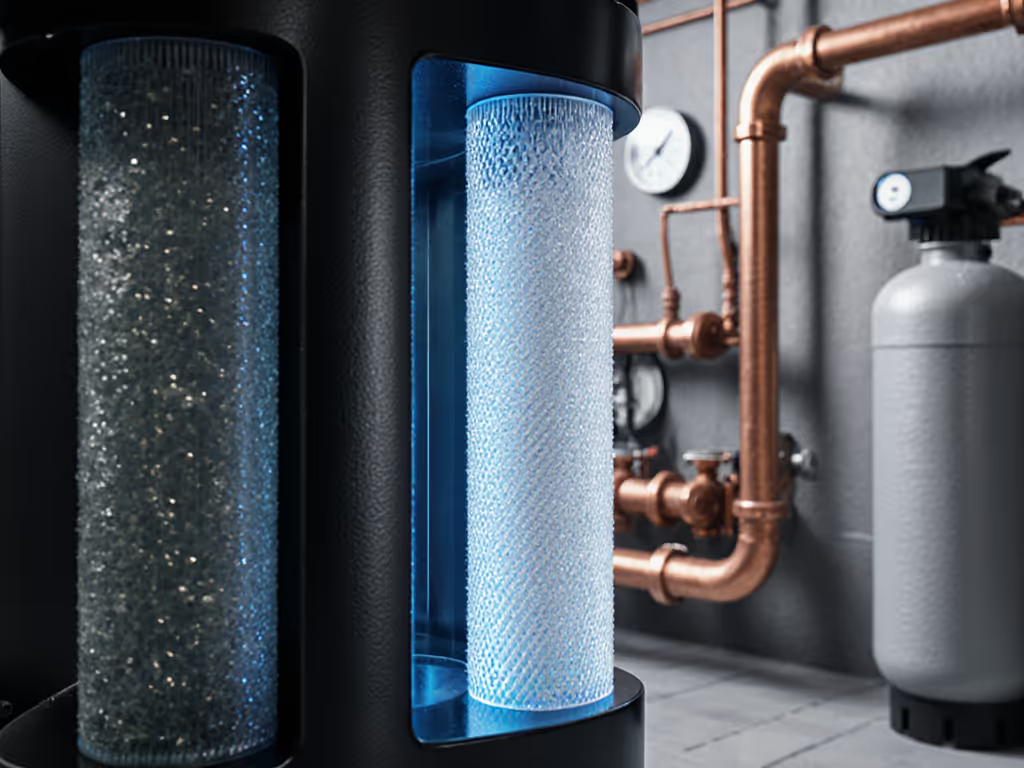
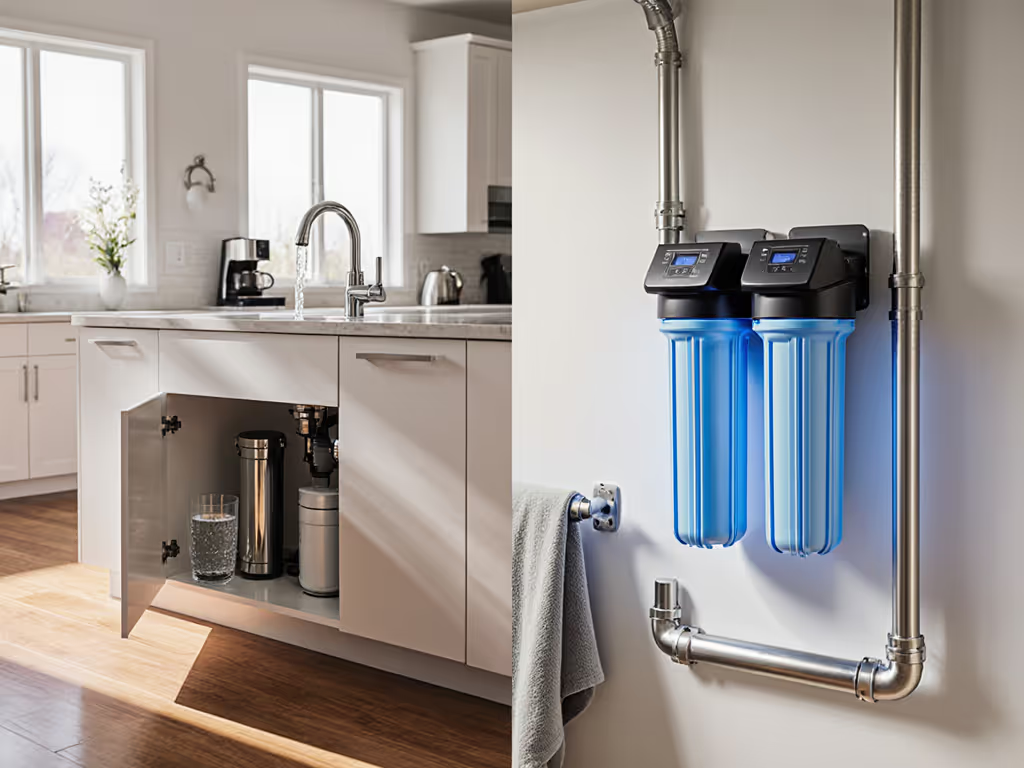
Before debating effectiveness, we must clarify the technical distinction. Point-of-use (POU) filters treat water at a single tap: countertop pitchers, faucet filters, or under sink filter systems. They are measured by flow rate (typically 0.5 to 1.0 GPM) and capacity (for example, 200 to 1,000 gallons per cartridge). Crucially, they target specific contaminants at the consumption point, not your shower or washing machine. Point-of-entry (POE) systems, including whole home filtration system installations, treat all water entering your home (typically 5 to 20 GPM flow rates). They sit where municipal or well lines enter your basement or utility closet, filtering every water-using fixture.
What gets overlooked: POU filters can't address dermal absorption or inhalation risks. Shower steam concentrates volatile contaminants like chlorine byproducts at up to 20x tap water levels (per EPA exposure studies). Meanwhile, POE systems don't guarantee drinking water purity, especially if contaminants leach from internal plumbing after the main filter.
The Comparison Framework: Data Over Dogma
Let's cut through the noise with five metrics verified by independent labs. I will reference NSF/ANSI standards because they are the only benchmarks with enforceable testing protocols, not brand-provided white papers. For a quick primer on which certifications matter for which contaminants, see NSF 42 vs 53.
1. Contaminant Coverage: Precision vs Breadth
POU systems excel at targeted removal when matched to certified reductions:
- Under sink filter with NSF/ANSI 53 certification: Proven 99% lead reduction at 15 ppb input (the EPA action level)
- Countertop RO unit (NSF/ANSI 58): 90 to 98 percent PFAS reduction down to 1 ppt
POE systems cover all entry points but face capacity trade offs:
- Sediment pre-filter (5 to 20 micron): Captures rust or silt but will not remove dissolved metals
- Activated carbon tank (NSF/ANSI 42): Reduces chlorine by more than 50% at 15 ppm but saturates faster with high flows
- Shower head water filtration alone misses 90% of household water use (showers are about 17% of indoor use per USGS)
Critical insight: POE systems often combine technologies (for example, carbon + copper zinc media) to broaden coverage. But without NSF/ANSI 53 certification for health contaminants like lead or arsenic, reduction claims are unverified. Always check the specific model's certification listing, not the brand's general claims.
2. Cost Per Gallon: The Hidden Math
Sticker price is meaningless without yield data. Here is how to calculate true cost:
Cost-per-gallon = (Cartridge cost + Installation cost) ÷ Certified capacity (gallons)
Example: A $120 under sink filter cartridge certified for 500 gallons = $0.24/gal
POE comparison: A $1,200 whole home system with 500,000 gallon carbon tank capacity = $0.0024/gal for the carbon stage (but add $200 pre-filter changes annually)
Reality check: Most POE systems require multi-stage maintenance. A "whole home filtration system" claiming $0.001/gal often omits:
- Sediment pre-filter costs ($50 to $150 per year)
- Carbon tank replacement every 3 to 5 years ($300 to $800)
- Potential salt or waste for softeners
3. Waste Footprint: Beyond Plastic Cartridges
POU systems generate concentrated plastic waste (for example, 12 cartridges per year = about 5 lbs plastic). RO units waste 3 to 5 gallons of water per gallon produced (NSF/ANSI 58 mandates recovery ratio reporting). POE systems minimize cartridge waste but cannot address RO waste downstream, if your under sink filter is RO based.
My calculation for a family of four:
- POU pitcher (40 gallon capacity): 26 cartridges per year × 0.4 lbs = 10.4 lbs plastic waste
- POE carbon system + non-RO under sink filter: 1 pre-filter + 1 carbon tank per year = about 8 lbs plastic (but 5x larger housings)
4. Installation Constraints: Renters vs. Homeowners
POU wins for flexibility:
- No-plumb faucet filter: $30, less than 10 minutes, zero tools required
- Countertop RO: Dedicated faucet needed (problematic for renters)
POE requires significant commitment:
- Whole home system installation: $500 to $3,000 labor (plus unit cost)
- Dedicated 3 to 5 sq ft floor space near main line
- Municipal code compliance (for example, backflow preventers in CA)
Hard truth: If you rent, POE is not viable unless your landlord installs it. Even then, HOAs frequently prohibit external POE units.
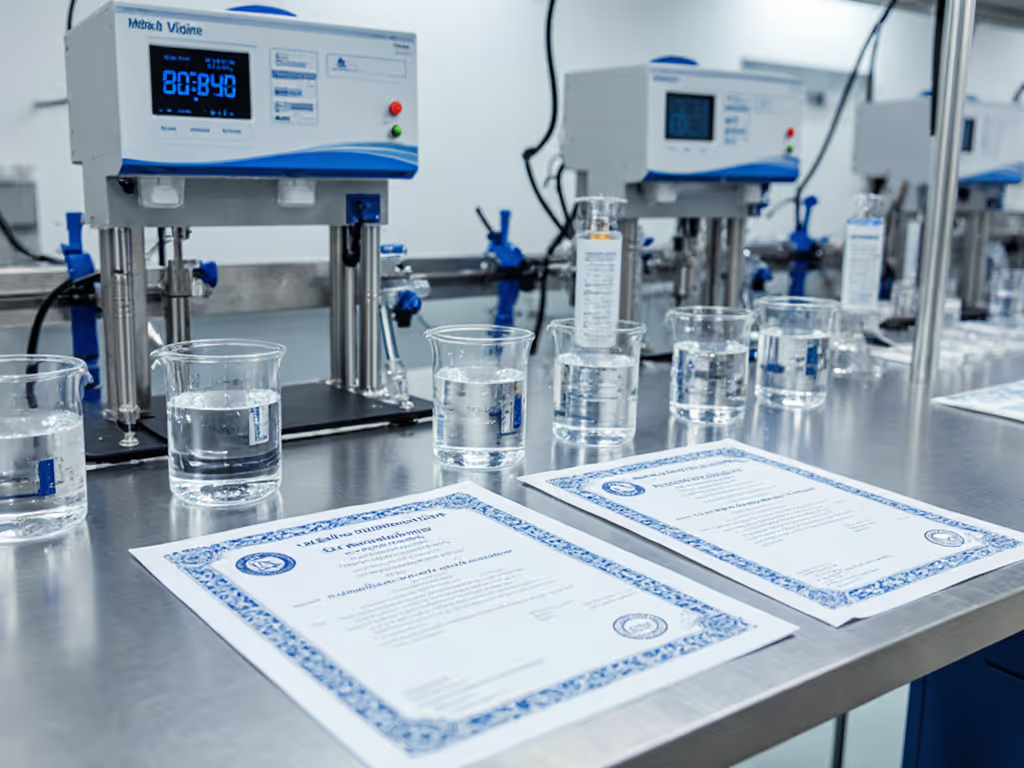
5. Performance Validation: The Certification Gap
This is where 90% of decisions fail. Verify claims against:
- NSF/ANSI 42: Aesthetic effects (chlorine, taste)
- NSF/ANSI 53: Health contaminants (lead, arsenic, VOCs)
- NSF P473: Specific PFAS reduction (not covered by 53)
- WQA Gold Seal: Independent verification beyond NSF
I have seen "whole home filtration system" marketing touting "99.9% reduction" but the test was for 1 micron particles, not dissolved lead. Always demand the certification report number from the seller. If they cannot provide it within 24 hours, walk away.
When to Choose Which: A Data-Driven Decision Matrix
Your water test report is the ultimate decider. Here is my framework based on 200+ household analyses:
| Scenario | Recommended Approach | Why | Key Certifications Needed |
|---|---|---|---|
| Renting urban apartment with lead service lines | POU under sink filter | Municipal water enters building filtered, but internal pipes leach lead | NSF/ANSI 53 (lead), 401 (PFAS if near industrial zone) |
| Home in hard water area (15+ gpg) with scale-damaged appliances | POE anti-scale + POU drinking filter | Softeners or conditioners do not remove health contaminants; RO needed for drinking | POE: NSF/ANSI 44 (softeners); POU: NSF/ANSI 58 (RO) |
| Well water with iron/manganese | Multi-stage POE (sediment + KDF) + UV | Bacteria or turbidity requires pre-filtration before point of use | POE: NSF/ANSI 44/55/53; UV: NSF/ANSI 55 |
| PFAS concerns near military base | POU RO (NSF P473) + POE carbon | Whole home carbon captures short-chain PFAS but may miss long-chain | POU: NSF P473; POE: NSF/ANSI 42 (chlorine) + heavy metal reduction |
Note: For shower head water filtration alone, consider it only if budget constrained and contaminants are volatile (for example, chlorine). It will not address ingestion risks.
The Verdict: Layered Protection Wins
My high rise crisis taught me: No single system solves everything. Today, my stack is:
- POE carbon tank (NSF/ANSI 42/53) for chlorine or lead reduction at entry point
- POU RO under sink filter (NSF P473) for PFAS-free drinking water
- Shower filter (NSF/ANSI 177) as supplemental dermal protection
Total cost-per-gallon: $0.18 after 5 years (vs. $0.25 for bottled water). Waste footprint: 80% less plastic than pitcher filters.
"Show your math" is not a slogan, it is the only way to cut through marketing. Your water's contaminant profile is unique to your ZIP code, plumbing age, and seasonal variations. Start with a certified lab test (municipal CCR or $20 well test kit), then demand model-specific NSF listings. A whole home filtration system might be overkill if your only concern is lead at the kitchen tap. Conversely, a $30 faucet filter will not stop scale from wrecking your water heater.
Your Action Plan: Beyond the Hype
- Test first: Request your municipal CCR or get a $35 well test kit (check for lead, arsenic, PFAS if near airports or industries) If you go the home-testing route, use our DIY water test guide to translate results into the right filters.
- Map gaps: Compare results to EPA MCLs (for example, lead = 15 ppb action level)
- Certify claims: For each contaminant exceeding limits, find filters with NSF/ANSI 53 or P473 listings
- Calculate true cost: Include all replacement parts over 5 years
- Verify capacity: Ensure flow rate meets household demand (for example, 5 GPM for simultaneous shower or dishwasher use)
The goal is not the "best" filter, it is the right filter stack for your water. Stop paying for what you do not need, and never trust a claim without seeing the lab report. Because when it comes to your water, the math does not lie.
Related Articles