PFAS Filters Ranked: NSF-Certified Systems Compared
By Arjun Mehta • 23rd Feb
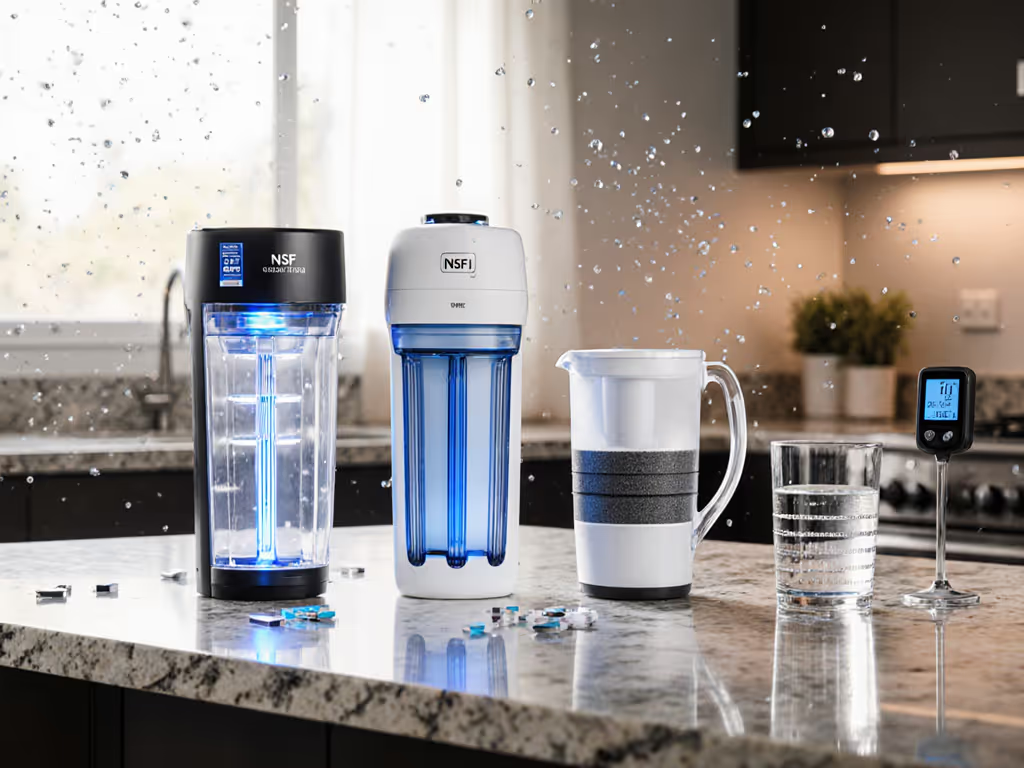
Choosing a home water filtration system for PFAS should start with your actual water profile, not marketing claims. The certified performance data tells a story that brand websites often obscure, and that story is the only one worth trusting.
After moving into a high-rise apartment years ago, I discovered that municipal confidence in water quality and what arrives at your tap are not always aligned. A chlorine spike and mineral scale in the kettle prompted me to pull the Consumer Confidence Report, cross-check lab data against my specific contaminants, and build a spreadsheet comparing certified reduction claims against real cartridge yields. The taste improved; the methodology stuck. Today, I translate certified PFAS removal standards into plain guidance so households can act with certainty instead of fear.
Common Confusion: Certifications and What They Actually Guarantee
When you see a water filter labeled "NSF certified," the standard number matters enormously, and most marketing materials gloss over this detail. For a clearer breakdown of what each certification covers, see our NSF 42 vs 53 guide and how it applies to PFAS claims.
What Do NSF/ANSI Standards Cover?
The NSF (National Sanitation Foundation) and ANSI (American National Standards Institute) maintain separate standards for different filter types and contaminants:
-
NSF/ANSI 42 - Addresses taste and odor reduction (primarily chlorine). It covers aesthetic concerns but does not include PFAS testing. If a filter carries only this mark, it will not reliably reduce "forever chemicals."
-
NSF/ANSI 53 - Covers health-related contaminants, including lead. Modern NSF/ANSI 53 certifications now include PFOA/PFOS removal testing for activated carbon-based filters. This is the critical benchmark for pitcher and gravity-fed systems targeting PFAS.
-
NSF/ANSI 58 - The reverse osmosis standard. It includes PFAS reduction testing and is most relevant for under-sink and countertop RO systems. This is the certification you want if you're installing an RO unit.
-
NSF/ANSI 401 - Addresses emerging contaminants such as some pharmaceuticals. Not PFAS-specific.
The key insight: if you're shopping specifically for forever chemicals filtration, you must look for either NSF/ANSI 58 (for RO) or NSF/ANSI 53 with explicit PFOA/PFOS claims (for carbon). A filter with only NSF 42 will not protect you from PFAS.
How Are PFAS Filters Actually Tested?
The IAPMO Laboratory Verification Process
Most serious PFAS filter claims are verified by IAPMO (International Association of Plumbing and Mechanical Officials), a third-party lab accredited to test under NSF/ANSI standards. The process works like this:
- The manufacturer submits the filter to IAPMO under controlled conditions.
- The lab introduces known concentrations of contaminants (in PFAS cases, PFOA, PFOS, and now other compound variants).
- The filter must reduce these contaminants to below the EPA health advisory level of 70 parts per trillion (PPT) for PFOA and PFOS.
- If successful, IAPMO certifies the filter and lists the specific compounds reduced.
This is expensive, rigorous, and most manufacturers skip it. Those who don't become standouts.
Why Not Just Rely on Manufacturer Claims?
Manufacturers can test their own products and publish "up to 99% removal" claims without third-party verification. This creates a credibility gap. Independent certification forces transparency: the NSF database lists exact contaminants, reduction percentages, and test conditions. A certified claim is auditable; a manufacturer claim is not.
Comparing Top NSF-Certified PFAS Filters
Based on rigorous third-party testing and certification data, here's how leading systems stack up:
Countertop Reverse Osmosis Systems
AquaTru Carafe - The highest-performing countertop RO system tested, this unit is certified by IAPMO to NSF/ANSI 53 for PFOA and PFOS reduction. In independent lab testing, it delivered near-identical contaminant reduction results to its larger Classic model. The Carafe carries certifications for standards 42, 53, 58, 401, and 372. If you're comparing non-plumbed systems, see our best countertop RO filters guide for apartment-friendly picks.
- Cost: $349+ initial; true cost-per-gallon varies by replacement cycle
- Strength: Highest-performing in independent testing, no installation required
- Trade-off: Higher upfront cost; countertop footprint
Under-Sink Reverse Osmosis Systems
Waterdrop G3 P800 - This high-efficiency under-sink RO system scored 9.21 out of 10 in testing and significantly reduced or removed 10 detected health-related contaminants. Like AquaTru, it carries an NSF/ANSI 53 certification specifically for PFOA/PFOS reduction. For RO-specific certification criteria, see Decoding NSF 58.
- Cost: $699 upfront; $0.11 per gallon ongoing (one of the lowest true costs per gallon among certified systems)
- Filtration rate: 800 gallons per day (GPD)
- Strength: Fast flow, low cost-per-gallon, certified PFAS reduction
- Trade-off: Installation required (~30 minutes DIY); weak setup experience per testing
- Warranty: 1 year, 30-day returns, free shipping to lower 48 states
Pitcher Systems
Culligan ZeroWater - This pitcher filter scored 9.33 out of 10 and is certified to NSF/ANSI 42, 53, 401, and 372. In lab testing, it completely eliminated fluoride and uranium (both initially exceeding health guideline limits), along with sulfate, nitrate, zinc, chlorine, copper, strontium, barium, and molybdenum.
- Cost: $24.99+ initial; $0.90 per gallon ongoing
- Filtration rate: 1.9 gallons per hour (GPH)
- Strength: Affordable entry point, comprehensive health-related contaminant reduction, NSF certified for PFAS
- Trade-off: Slower flow; higher cost-per-gallon than under-sink RO
- Warranty: 90 days
Clearly Filtered Pitcher - NSF certified to standards 42 and 53, this pitcher-based system scored 8.78 out of 10. It uses activated carbon media.
- Cost: $90 initial
- Strength: Mid-range affordability; no installation
- Trade-off: Slower than ZeroWater; fewer NSF certifications than top performers
Gravity-Fed Systems
Culligan MaxClear - The only gravity-fed filter tested that carries NSF/ANSI 53 certification specifically for PFAS reduction (as well as lead removal). This is noteworthy because gravity filters are typically cheaper but rarely pursue rigorous certification.
- Cost: $229.99+ initial
- Strength: IAPMO-certified PFAS reduction without electricity or plumbing; lower maintenance overhead
- Trade-off: Slower filtration than powered systems; higher cost-per-gallon than under-sink RO
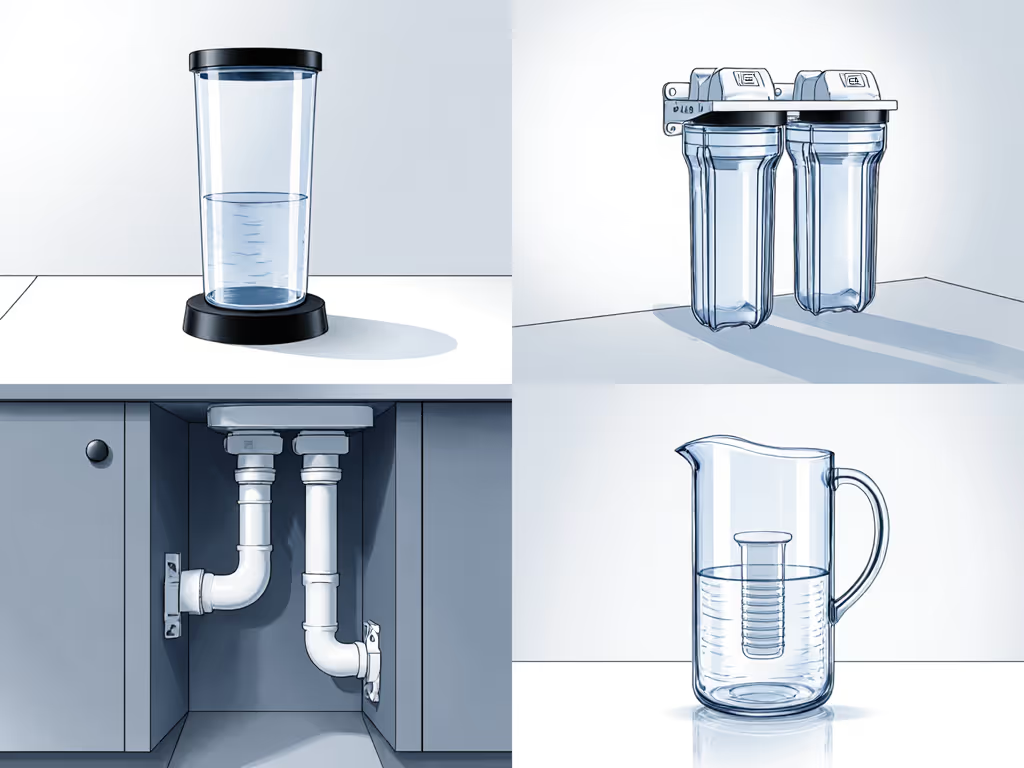
Critical Metric: Cost-Per-Gallon Over Time
Many homeowners focus on upfront price and miss the true operating cost. Here's why it matters:
| System | Upfront | Cost/Gallon | Annual Cost (family of 4) |
|---|---|---|---|
| Culligan ZeroWater | $25 | $0.90 | ~$1,200-1,400 |
| Culligan MaxClear | $230 | ~$0.50-0.75 | ~$650-1,000 |
| Waterdrop G3 P800 | $699 | $0.11 | ~$150-200 |
| AquaTru Carafe | $349 | Variable | ~$400-700 |
| Clearly Filtered | $90 | Variable | ~$500-800 |
The Waterdrop G3 P800 shows why cost-per-gallon calculation is crucial. Despite a high upfront cost, its low operating cost (achieved through a higher water recovery ratio and longer cartridge life) makes it the most economical over 3-5 years for households with high consumption.
How to Map Your Water and Choose Correctly
Map your water, then let certifications drive the filter choice. This process has three steps:
Step 1: Know Your Contaminants
Request your local Consumer Confidence Report (CCR) from your municipality or well-test data if you're on a private system. Use our CCR interpretation guide to translate the numbers into action items. This report lists detected contaminants, their concentrations, and whether they exceed EPA limits. Write these down (this is your filter's job description).
Step 2: Verify Certifications for Your Specific Contaminants
Visit the NSF website directly and search for the filter model you're considering. The database will list each NSF certification and the specific contaminants it covers. Don't rely on product pages; go to the source.
If PFAS appears in your CCR, ensure the filter carries either NSF/ANSI 58 (RO) or NSF/ANSI 53 with explicit PFOA/PFOS language (carbon). A filter certified for lead but not PFAS will not solve a PFAS problem.
Step 3: Calculate True Total Cost
Multiply the cost-per-gallon by your household's monthly consumption (rule of thumb: 40-50 gallons per person per month for drinking and cooking, depending on climate). Add cartridge replacement costs over a 3-year ownership window. This number will inform whether a higher upfront cost actually saves money long-term.
Why Third-Party Certification Matters More Than Performance Claims
A manufacturer stating "removes up to 99.5% of PFAS" on a spec sheet is not verified. An IAPMO certification under NSF/ANSI 53 or 58 is. The difference is the difference between marketing language and auditable proof.
Few manufacturers go through the rigor and expense of obtaining NSF/ANSI 53 or 58 certification specifically for PFAS. That's why systems like AquaTru, Waterdrop G3 P800, and Culligan MaxClear stand out (they've documented their claims under controlled laboratory conditions).
Waste and Sustainability Considerations
Reverse osmosis systems produce reject water (typically a 3:1 or 4:1 ratio of wastewater to filtered water, depending on input water quality and pressure). Over five years, an RO system may send 10,000-15,000 gallons to drain while yielding 3,000-5,000 gallons of drinking water. Higher-efficiency RO models like the Waterdrop G3 P800 improve this ratio, reducing waste.
Pitcher and gravity filters generate plastic-heavy cartridges every 2-4 months. Some manufacturers now offer recycling programs; check before purchase if waste footprint concerns you.
What to Explore Next
Once you've confirmed your water profile and prioritized your contaminants, the next step is narrowing by installation constraints and flow rate tolerance. Renters may need a countertop-only solution; homes with low water pressure may struggle with under-sink RO; households with high chlorine taste may prioritize NSF/ANSI 42 + 53 combination certs over a PFAS-only focus.
Review the specific certifications listed on the NSF website for your shortlisted models. Compare cost-per-gallon using your household's actual water consumption and replacement schedule. Request the cartridge replacement cost and expected lifespan in writing from the manufacturer: vague claims about "12 months or 500 gallons, whichever comes first" hide surprises.
Finally, if you live in a region flagged for PFAS (Michigan, Ohio, North Carolina, New Jersey, Pennsylvania, and parts of the Mountain West), prioritize filters with NSF/ANSI 58 or explicit NSF/ANSI 53 PFAS certs over general "health" certs. The data is clear: map your water, then let certifications drive your decision. Promotions and brand loyalty won't improve the water in your glass, third-party verification will.
Related Articles
Agricultural Runoff Filters: Proven Pesticide Removal
Choose a home filtration setup that truly reduces pesticides from farm runoff with a test-first plan: understand the five factors that drive removal, compare lab-verified systems, and budget for replacements. Pair sediment pre-filtration and catalytic carbon, control flow rates, and set a maintenance schedule that sustains protection.
Fluoride vs Arsenic Filters: NSF Verified Comparison
Learn which NSF/ANSI certifications actually prove fluoride and arsenic reduction (58 for fluoride; P231/P473 for arsenic) and why many popular pitchers don’t qualify. Use the audit checklist - verified reduction at rated flow, waste ratio, remineralization, and arsenic III pre-oxidation - to choose a system matched to your water.