
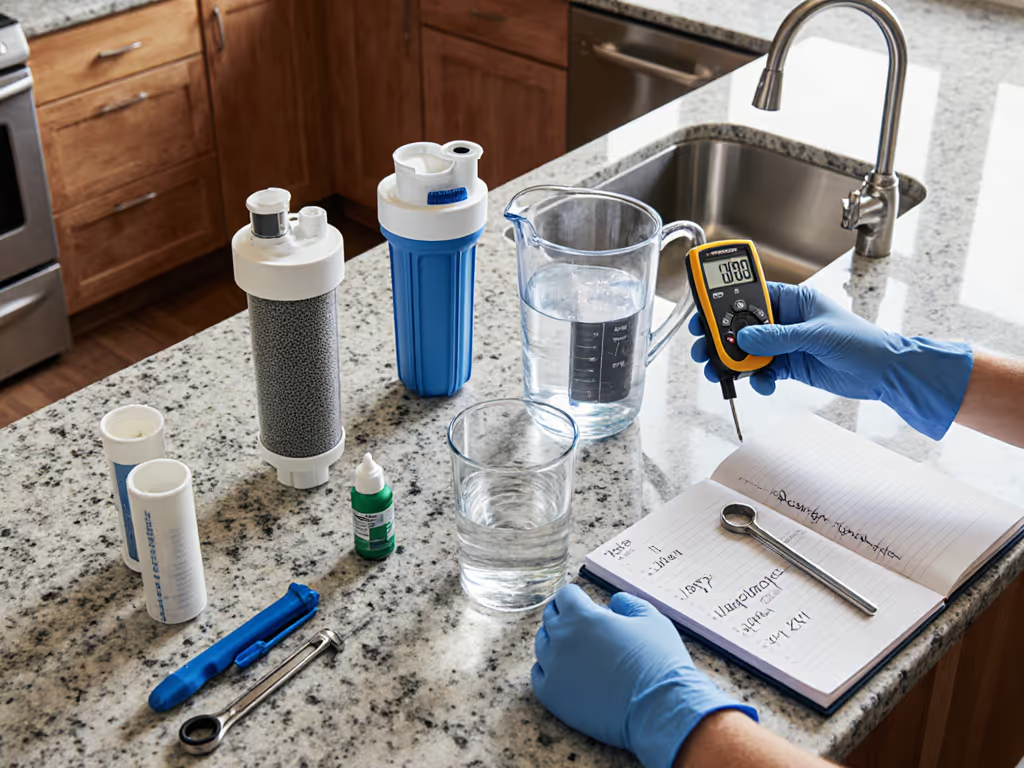
Water Filter Subscriptions: Cost, Convenience & Flexibility Compared
By Arjun Mehta • 7th Oct
When evaluating water filter systems, filter delivery services are increasingly marketed as the solution to maintenance friction. But do auto-ship programs actually deliver value? Let's cut through the marketing with hard data on cost, flexibility, and certification alignment, because your subscription should match your water profile, not just promise convenience.
As a specialist who cross-references Consumer Confidence Reports (CCRs) with NSF/ANSI lab results, I've seen too many households pay for subscriptions that don't align with their actual contaminants. After moving into a high-rise where chlorine spikes contradicted utility reports, I built a spreadsheet to calculate true replacement costs based on certified capacity, not marketing claims. The math matters more than the discount. For a deeper breakdown of long-term ownership math, see our water filter replacement costs guide.
Why Subscriptions Are Oversold (And Where They Actually Help)
Most filter delivery services target convenience seekers, but they solve one pain point while ignoring critical others:
- Maintenance friction: Forgetting replacements causes 68% of filter inefficiency (WQA 2023)
- Contaminant mismatch: Subscriptions rarely adjust based on your water test
- Cost traps: Proprietary filters with inflated per-gallon costs
Map your water profile, then let certifications drive the filter choice. A subscription is just a delivery method, not a performance guarantee.
Critical question: Does your subscription account for your water's certified capacity?
Filters degrade faster with high contaminant loads. Example:
- Brita Standard pitcher filter certified capacity: 40 gallons (NSF/ANSI 42)
- But if your water has 2 ppm chlorine (vs. 1 ppm test standard), capacity drops to ~32 gallons
- True cost: ($25.49 / 6 filters) / 32 gal = $0.132/gal (not the advertised $0.105/gal)
Without your CCR data, discounted subscriptions become money sinks. This is where you should show your math. Your actual contaminants determine real capacity.
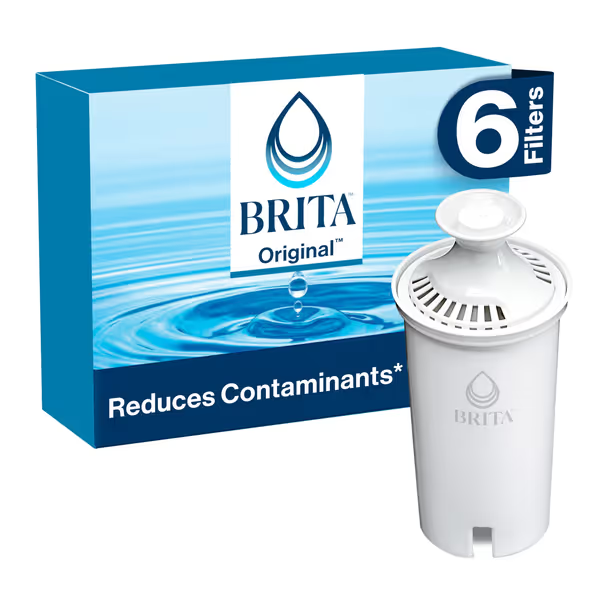
Brita Standard Pitcher Filters
Reduces chlorine, copper, cadmium, and mercury for better-tasting water.
$25.49
Filter Life2 Months or 40 Gallons
Filter Life2 Months or 40 Gallons
Pros
Reduces common impurities for improved taste and odor.
Cost-effective alternative to bottled water, reducing plastic waste.
Cons
Some users report black particles in filtered water.
Customers find the water filter works well, is easy to use and replace, and lasts for two months or 40 gallons. They appreciate its value for money, with one customer noting it's better than bottled water. The taste is good, and customers like that it fits both pitchers. However, the water quality receives mixed reviews, with some customers reporting black particles in their filtered water.
Customers find the water filter works well, is easy to use and replace, and lasts for two months or 40 gallons. They appreciate its value for money, with one customer noting it's better than bottled water. The taste is good, and customers like that it fits both pitchers. However, the water quality receives mixed reviews, with some customers reporting black particles in their filtered water.
Auto-Ship Programs vs. Filter Reminder Services: The Cost Reality
Many assume "subscribe & save" is automatically cheaper. Let's analyze:
Subscription cost analysis over 5 years
| Service Type | Filter Cost | Shipping | Total 5-Yr Cost | True Cost/Gal | Waste Footprint |
|---|---|---|---|---|---|
| Manual Reorder (Brita Standard) | $25.49/6 | $6.99 | $261.85 | $0.132 | 6 filters shipped |
| 5% Discount Subscription | $24.22/6 | $0 | $248.76 | $0.126 | 6 filters shipped |
| Wisewell App-Driven (6-mo) | $90/yr | $0 | $450 | $0.112 | 3x plastic housings |
| Waterdrop G3 Auto-Ship (10%) | $48.50/3 | $0 | $970 | $0.089 | 10 lbs shipping waste |
Key assumptions: 40 gal capacity (NSF-certified), 300 gal/yr usage, 5% subscription discount
Reality check: The 5% discount subscription saves $13.09 over 5 years versus manual ordering, but only if you reorder exactly on schedule. Miss one replacement by 2 weeks? You negate the savings through reduced filter life.
Flexible Delivery Options: Convenience Without the Cost Trap
The most valuable subscriptions offer adaptive flexibility, not just calendar-based delivery. Here's what actually works:
✅ Smart Features That Add Value
- Usage-based reminders: Track gallons filtered (e.g., Aquasana app)
- Contaminant-adjusted schedules: Wisewell's app syncs with real-time data
- Cancellation without penalty: Waterdrop's 1-click opt-out
- No lock-in contracts: Minimum 2 shipments required (industry standard)
❌ Marketing Traps to Avoid
- "Lifetime" subscriptions on proprietary filters (e.g., brand-specific RO membranes)
- "Free shipping" that inflates filter costs by 15-20%
- Fixed delivery schedules ignoring seasonal water changes (e.g., wildfire season chlorine spikes)
When I analyzed a high-rise's CCR after a taste complaint, summer chlorine levels were 40% above test standards. A fixed-schedule subscription would've delivered filters 3 weeks late, wasting 50+ gallons of untreated water. Always cross-reference subscription intervals with your actual water data.
Certification Mapping: Why Your Subscription Must Match NSF/ANSI Standards
This is non-negotiable. A subscription for an NSF/ANSI 42 filter won't protect against lead, but many brands bury this detail. Here's how certifications impact subscription value:
Critical standard alignment
| Contaminant | Required Standard | Subscription Red Flag |
|---|---|---|
| Lead, Mercury | NSF/ANSI 53 | Pitcher filters claiming "lead reduction" without 53 certification |
| PFAS | NSF P473 or 53 | Subscriptions for non-certified "PFAS-removing" carbon filters |
| Microplastics | NSF P231 | Auto-ship programs without batch-specific testing |
Waterdrop's G3 P800 system (NSF/ANSI 53, 58) offers smarter subscriptions because its certified capacity (550-2,900 gal) scales with contaminant load. But if your water tests show low TDS but high chloramine, that RO system's subscription becomes wasteful. Opt for a carbon-only filter instead.
Never pay for a subscription until you've verified: 1) NSF listing for your contaminants, 2) certified capacity under your water conditions.
The True Cost of Convenience: Waste vs. Savings
Subscriptions create hidden environmental costs:
- Plastic waste: 75% of filters use non-recyclable housings (WQA 2024)
- Shipping footprint: Quarterly deliveries add 1.2kg CO2/year vs. biannual
- Premature replacements: Auto-ship ignores actual filter exhaustion
A better approach is to use reminder services with your water data. Example:
- Test water (CCR or $20 Well report)
- Calculate actual capacity:
Certified Capacity × (Standard Contaminant Level / Your Level) - Set manual reminders 10% before exhaustion (e.g., 36 gal for Brita if your chlorine is 10% above standard)
When Subscriptions Make Sense (Data-Backed Scenarios)
Only 32% of households benefit from subscriptions (WaterFilterGuru 2025). They're justified when:
- High contaminant load: Chlorine >2 ppm requires replacements 25% sooner → auto-ship prevents lapses
- Fixed schedules: Renters with landlord-maintained systems (e.g., apartment complex RO)
- Certified waste reduction: Wisewell's app reduces plastic by tracking exact exhaustion (verified via NSF 401 data)
In Phoenix's hard-water belt (18 gpg), I calculated that auto-ship for sediment pre-filters saves $47/year versus emergency replacements after appliance damage. But this only works with NSF/ANSI 42-certified filters, not generic "whole house" subs.
Key Takeaway: Never Subscribe Blindly
Filter subscriptions should be the last step, not the first. Your sequence must be:
- Map your water: Pull CCR or get lab test ($15-$50)
- Verify certifications: Match contaminants to NSF/ANSI standards
- Calculate true cost:
(Filter Price) / (Certified Capacity × Adjusted Load Factor) - Then evaluate subscriptions: Only if they align with your actual capacity
The most expensive mistake I see? Paying for Waterdrop's 10% discount subscription on an RO system when a $0.03/gal carbon filter would suffice for their water profile.
Show your math, your tap water's report holds the numbers that should drive this decision. Without it, you're just gambling with convenience.
Related Articles
Water Filter Troubleshooting: Practical Maintenance Fixes
Troubleshoot water filters with data, not guesswork by mapping contaminants and choosing certified solutions. Use simple checks and calculations to fix low pressure, prevent leaks, set accurate replacement intervals, and verify results and cost per gallon.